

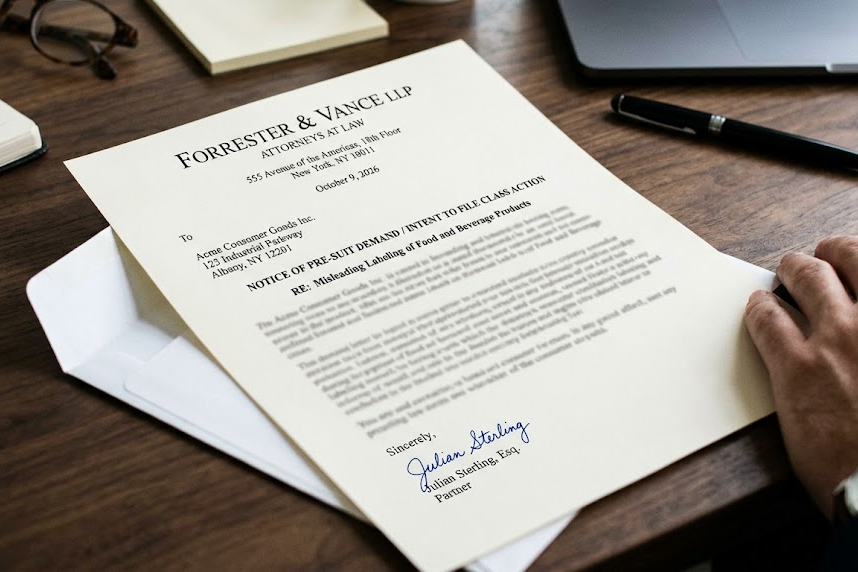
A demand letter claiming that your food or beverage label is misleading usually arrives before any lawsuit is filed. It may cite New York General Business Law §§ 349 and 350, the New Jersey Consumer Fraud Act, the Pennsylvania Unfair Trade Practices and Consumer Protection Law, the Maryland Consumer Protection Act, or several of them. It may be sent on behalf of a proposed class, and it sets a short deadline. What a company does in the first ten days affects its insurance coverage, its evidence, and its options later. This post walks through those days and notes where the answer changes by state.
Read the letter before reacting to it
Start by working out what kind of letter it is.
Who sent it, and for whom. A letter from one consumer is different from one sent for a proposed class. Note whether it names a law firm and whether that firm has filed similar claims against other brands.
What it claims, and under which state’s law. Identify the product, the label statement at issue (for example, “natural,” “made with,” or a featured ingredient), and the statutes listed. A letter that cites several states’ laws usually signals a plan to file a multistate or nationwide class.
What it asks for. Most letters ask for a payment, a label change, or both, and some demand a response within a stated number of days.
What it says about notice. Letters often state that they are notice of breach of warranty. Pre-suit notice matters because New York federal courts have dismissed warranty claims where it was not adequately alleged, as in Clemmons v. Upfield US Inc., 667 F. Supp. 3d 5 (S.D.N.Y. 2023), and Reyes v. Upfield US Inc., 694 F. Supp. 3d 408 (S.D.N.Y. 2023). Other states handle warranty notice differently, so counsel should check the rule in the state where the sender bought the product. Do not assume the letter’s deadline is a legal deadline, and do not ignore it either.
Treat the letter as a document that may be used later. Keep the original, the envelope or email, and the date you received it.
Why the state matters
The same label can face different exposure depending on where the buyer lives and where a case is filed. The table is a starting point for the conversation with counsel, not a substitute for it.
State | Main statute | What tends to change the response |
New York | GBL §§ 349 and 350 | No reliance element; the court asks whether a reasonable consumer would be misled; many cases are decided on the label at the pleading stage |
New Jersey | Consumer Fraud Act, N.J.S.A. 56:8-1 et seq. | Requires an ascertainable loss but not reliance; a successful plaintiff can recover treble damages and attorney’s fees |
Pennsylvania | Unfair Trade Practices and Consumer Protection Law, 73 P.S. § 201-1 et seq. | Private plaintiffs generally must show justifiable reliance and a loss of money or property; courts may treble damages and award fees |
Maryland | Consumer Protection Act, Md. Code, Com. Law § 13-101 et seq. | Private actions require actual injury or loss; fee shifting is available; reliance and class treatment are contested issues to review |
Three practical points follow:
The federal circuit differs. New York federal courts sit in the Second Circuit, where Mantikas is binding authority on how the ingredient list interacts with the front label. New Jersey and Pennsylvania federal courts sit in the Third Circuit and Maryland’s in the Fourth, so Mantikas is persuasive there but does not control. Counsel should look at how courts in the sender’s state have treated similar claims.
Fee shifting changes the math. Where a statute lets a winning plaintiff recover attorney’s fees or multiple damages, the cost of losing is higher, and that can push a company toward early resolution even when it thinks it would win.
A multistate letter may be aimed at a settlement class. Responding in one state’s terms alone can miss the exposure in the others.
Days 1 and 2: notify your insurer and preserve documents
Tell your insurance carriers. Notice provisions in liability policies, often general liability, product liability, or an umbrella policy, can require prompt notice of a claim or a circumstance that may lead to one. A demand letter may count. Late notice can create coverage problems, and the rules on whether the insurer must show it was harmed by the delay differ by state. Send written notice to every carrier and broker that may be involved, including prior-year carriers if the product has been on the market for a while, and ask the broker to confirm receipt. Many food-labeling claims fall outside standard policies or are subject to exclusions, so the notice is about preserving rights, not assuming coverage.
Issue a litigation hold. Once a claim is reasonably anticipated, the company should keep relevant documents and data. A written hold should go to the people who touch the product and the claim, and should cover:
label and packaging artwork, drafts, approvals, and the final printed versions, for every version of the product at issue;
formulation records, ingredient specifications, and supplier documents;
marketing materials, website copy, and social media posts about the product;
sales, pricing, and distribution data;
consumer complaints and customer service records about the label;
emails and chats that discuss the label claim, including text messages on personal phones if business is conducted there.
Suspend any automatic deletion that could reach these materials. Destroying or losing records after a claim is anticipated can lead to sanctions, even if the destruction was routine.
Days 2 through 4: decide who responds, and who does not
Pick one point of contact. Route all communication about the letter through one person and, ideally, outside counsel. Sales staff, customer service, and executives should be told not to reply to the sender or discuss the claim with customers, retailers, or reporters.
Do not respond on your own. An informal reply can include statements that are later quoted back, and can accidentally concede facts about the label or the product. Counsel can reply, or can deliberately hold off while the facts are gathered, and should decide which.
Do not post publicly. Resist the urge to defend the product on social media, in a press statement, or in reviews. Public statements are not privileged, can be used as evidence of what the company knew or intended, and can draw attention from other plaintiffs’ firms. If a customer asks about the claim, give a short approved holding statement.
Keep internal discussion careful. Communications with counsel for the purpose of legal advice may be privileged. Casual emails among employees speculating about whether the label is misleading may not be. Ask people to bring questions to counsel, not to write opinions in email.
Days 3 through 7: assess the claim
With the hold in place, counsel can look at the merits. The questions are specific:
What does the front label actually say, and what does the whole label say? New York courts read the label as a whole, and an ingredient list or Nutrition Facts panel can sometimes clear up a merely ambiguous front claim. But the list will not rescue a front label that is itself misleading, as the Second Circuit held in Mantikas v. Kellogg Co., 910 F.3d 633 (2d Cir. 2018). Our post on the reasonable consumer test explains where that line falls.
Is the claim about composition? Claims that a featured ingredient predominates, or that a product is “natural” or has “no artificial flavors,” have survived motions to dismiss in several New York decisions. Whether courts in New Jersey, Pennsylvania, or Maryland would reach the same result is a question for state-specific research.
Is the claim consistent with the facts? Review the formulation and specifications against the label statement before taking a position.
Are there other defenses? Federal preemption, standing, whether the plaintiff actually bought the product, and the adequacy of the notice may apply depending on the claim. These are separate issues from the reasonable-consumer argument.
Where could suit be filed, and under which statute? See the table above. The claimant’s home state, where the product was sold, and any arbitration or venue terms on the company’s website or packaging can all affect the answer.
Days 7 through 10: early resolution or fight
By this point the company should have enough information to choose a direction. There is no single right answer, and the choice can change as facts develop.
Reasons to consider resolving early
The label may be genuinely vulnerable, for example a featured-ingredient claim that the ingredient list contradicts.
The claim is brought under a statute with fee shifting or multiple damages, which raises the cost of losing.
The sender is an individual or a small group, and the cost of an early resolution is far below the cost of defending a case.
The company is willing to change the label anyway, which can be offered as part of a resolution.
Resolving before a class is filed may avoid public attention and a record that other plaintiffs can use.
Reasons to fight
The label, read as a whole, does not say what the sender claims, and similar claims have been dismissed.
A payment may invite more letters. Some firms send many similar demands and pursue those that pay.
A class filing is unlikely to be cost-effective for the claimant, or the product has a small New York footprint.
The company wants to establish that the label is accurate.
Whichever path is chosen, ask counsel to handle settlement communications under rules that protect them from later use as evidence of liability, such as Federal Rule of Evidence 408 and CPLR 4547, and to address in any agreement what is released, whether there is an admission, whether the terms are confidential, and whether the company will change the label. A label change made while a claim is pending should be coordinated with counsel, because the timing and wording can be used by the other side.
A short checklist for the first ten days
Day 1: Save the letter and envelope or email. Calendar any stated deadline.
Days 1 and 2: Send written notice to all possible insurance carriers and brokers.
Days 1 and 2: Issue a written litigation hold and suspend automatic deletion.
Days 2 through 4: Name one point of contact, retain counsel, and tell staff not to respond or post.
Days 3 through 7: Gather label versions, formulation records, and complaint history; assess the claim.
Days 7 through 10: Decide on early resolution, a response that defends the label, or further investigation, and reply to the sender through counsel.
Outcomes depend on the specific label, the claim, and the court. This is general information, not legal advice.
Frequently asked questions
Do we have to respond to the deadline in the demand letter?
The deadline is set by the sender, not by law. It is usually worth responding through counsel before it passes, but the response may be a request for more information or for time, not a substantive answer.
Should we tell our insurance company even if we think the claim is weak?
Generally yes, and promptly. Policies often require notice of claims or circumstances, and late notice can create coverage problems. Whether the policy actually covers the claim is a separate question.
Can we change the label right away?
You can, but coordinate it with counsel first. A change can be part of a resolution, but its timing and wording can also be cited by the other side.
Should we post a statement defending the product?
No. Public statements can be used against the company and are not protected like communications with counsel. Use a short holding statement and route questions to one person.
Does a demand letter mean a lawsuit is coming?
Not always. Some letters lead to a filed case and some end after a response or a small resolution. Handling the first days carefully keeps both options open.
Does it matter which state the sender lives in?
Yes. The applicable statute, the reliance and injury requirements, the remedies, the federal circuit, and the warranty notice rule can all differ. A multistate letter should be assessed state by state.
Can the claim be dismissed early?
Often, depending on the label and the court. See our post on the reasonable consumer test for how New York courts decide this at the pleading stage. Courts in other states apply their own standards.

